Oystercatchers are a relatively large shorebird, weighing between one and two pounds. There are currently 11 species globally. There were 12, but one — the Canary Island Oystercatcher — went extinct in the 1940s. Two species are in North America, two in South America, two in Africa with one of these extending into Europe, three in New Zealand, and two in Australia.
I’ve been fortunate to see 6 of the 11 species: 2 in North America, 2 in South America, and 2 in Africa. Perhaps some day I’ll be fortunate enough to travel to New Zealand and Australia to see the remaining 5 species.
Here are photos I’ve taken of the Oystercatchers I’ve seen.
American Oystercatcher
Haematopus palliates
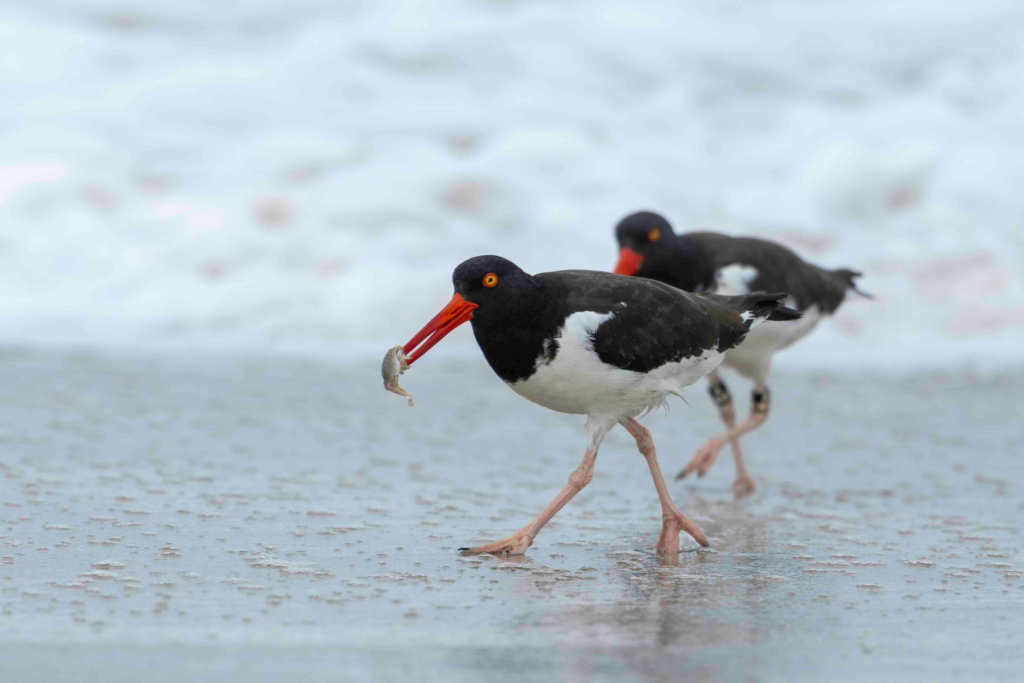
Found mostly along the Atlantic Coast. Conspicuously colored with bright orang bill and contrasting black and white, with pale pink legs and yellow eye with red eye ring.
This picture was taken in late September 2024 while on a camping trip at Assateague Island. These 2 were with a group of 6 foraging along the wave line. Note the bands on the bird in the background. I was able to get other pictures to read the band numbers. This bird was a first year and had been banded in a nest nearby 8 weeks earlier.
Black Oystercatcher
Haematopus bachmani
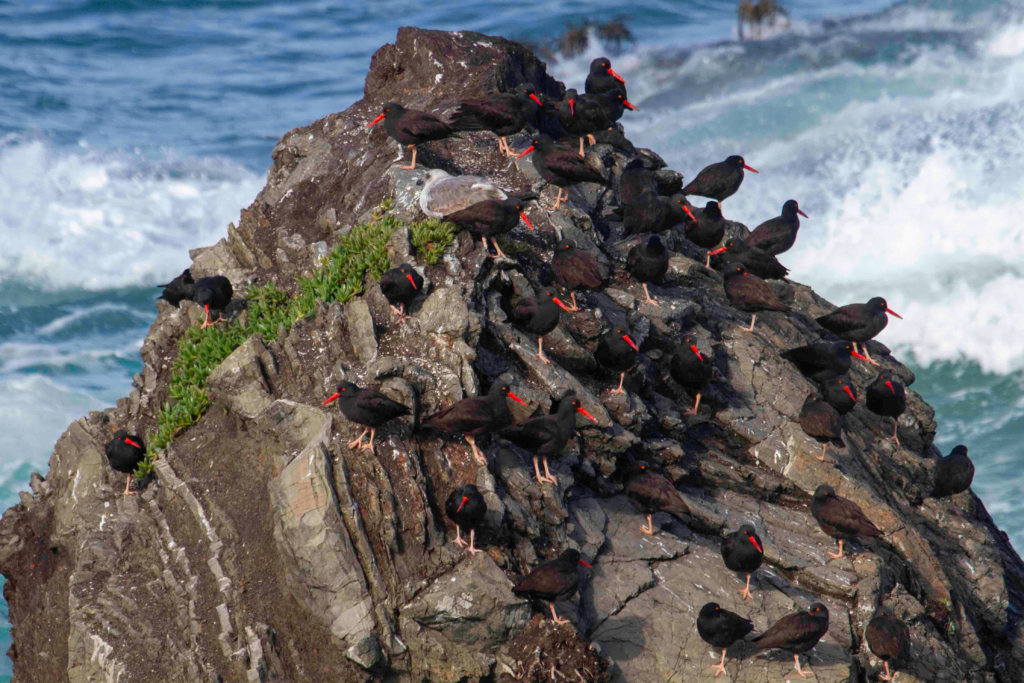
Black Oystercatchers are found on the Pacific Coast. I saw them often when we lived in Norther California and would take weekend trips to visit Janet’s brother and his wife in Mendocino. Large flocks would congregate along Mendocino’s rocky headlands.
Black Oystercatchers are all black, except for their red-orange bill, pink legs, and yellow eye with a red eye ring. A gregarious bird, they can be quite noisy while flying along the coast.
African Oystercatcher
Haematopus moquini
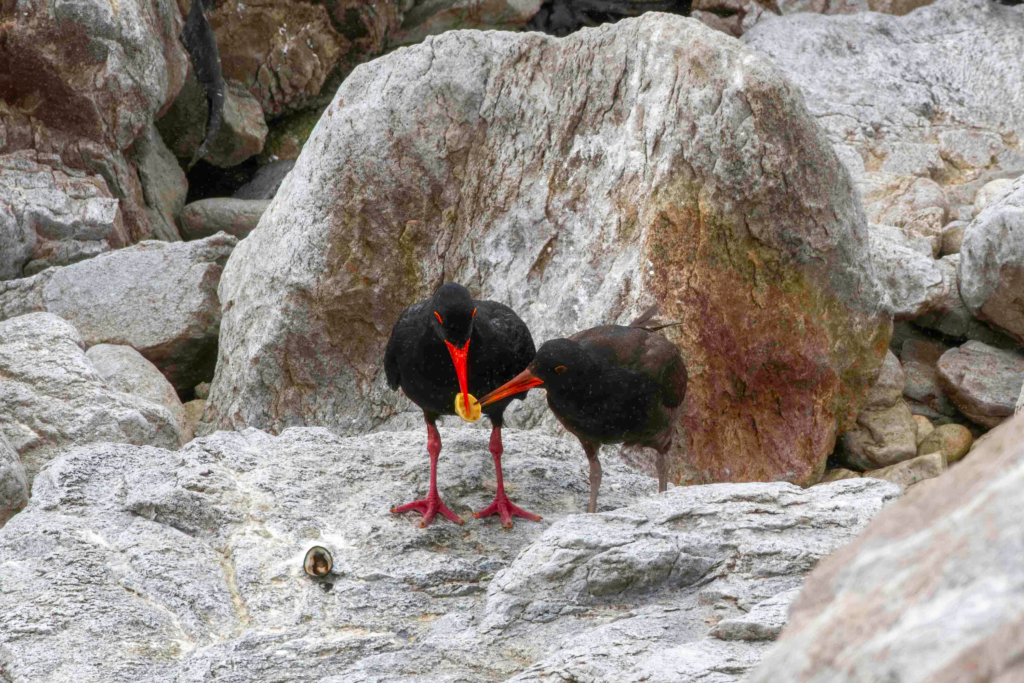
Another all Black Oystercatcher, it is found along the coast of southern Africa, ranging from Namibia south to Cape of Good Hope, then extending to the northeast to the southern coast of Mozambique.
In addition to being all black, it has a red (not yellow) eye with an orange-red eye ring and bill, with pinkish red legs.
I saw African Oystercatchers while on a bird trip to South Africa in January 2022. The picture taken here was at Stony Point Penguin Colony, known as a convenient location to view African Penguins. The bird on the right is an immature being fed a mollusk by its parent.
Eurasian Oystercatcher
Haematopus ostralegus
Currently, there are 4 subspecies of Eurasian Oystercatchers, so there’s a chance that further taxonomic research will determine some of these will be split into full species. But who knows if and when that will happen.
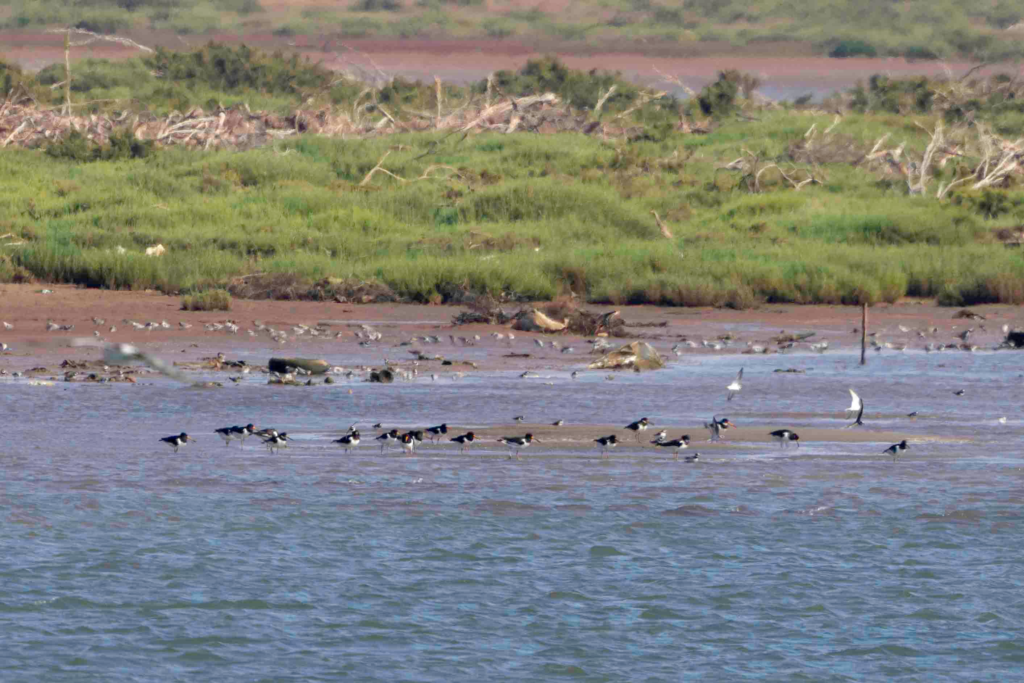
Eurasian Oystercatchers are similar in appearance to American Oystercatchers, will all black heads, baks, and neck contrasting with all white breast and belly. They have a red eye and eye-ring with an orange-red bill and pink legs.
This picture was taken on May 1, 2026, near Agadir, Morocco, in the Souss Estuary. Unfortunately the flock stayed in the distance, so I was unable to get a decent close in shot of the birds.
Magellanic Oystercatcher
Haematopus leucopodus
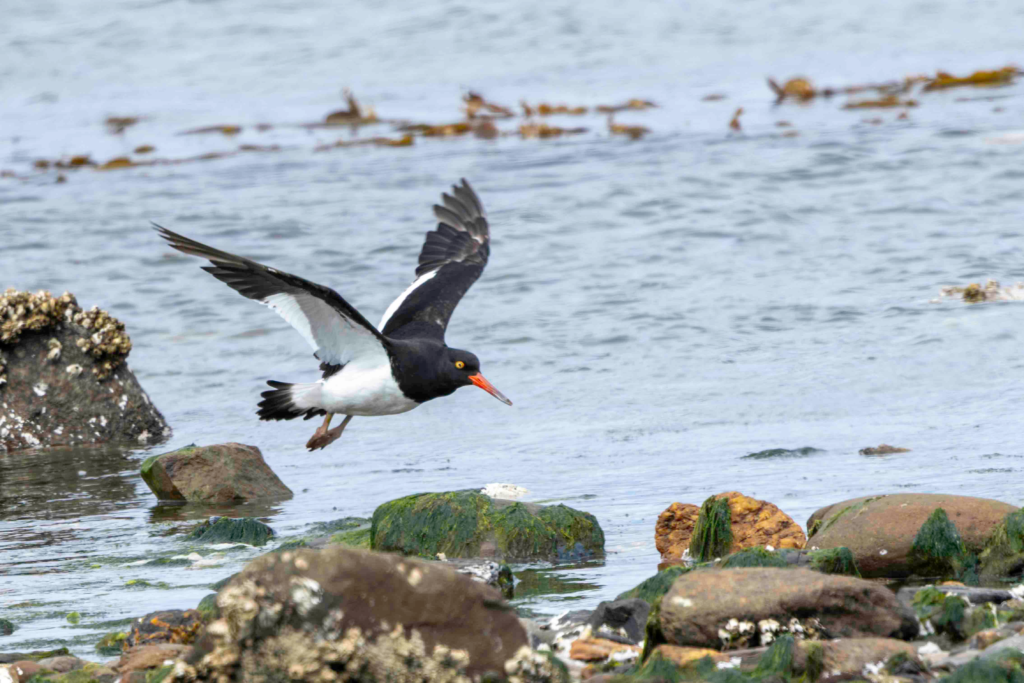
Found in the South America, from Chile and South Argentina to Cape Horn and the Falkland Islands, the Magellanic Oystercatcher is one of the black-and-white species. It has an orange bill, yellow eyes, a red eye-ring, and pink legs.
This picture was taken in Ushuaia, Argentina, on December 5, 2004, the day before we boarded the ship for our Antarctica adventure with Roads Scholars. We saw it as well as the Blackish Oystercatcher, shown below.
Blackish Oystercatcher
Haematopus ater
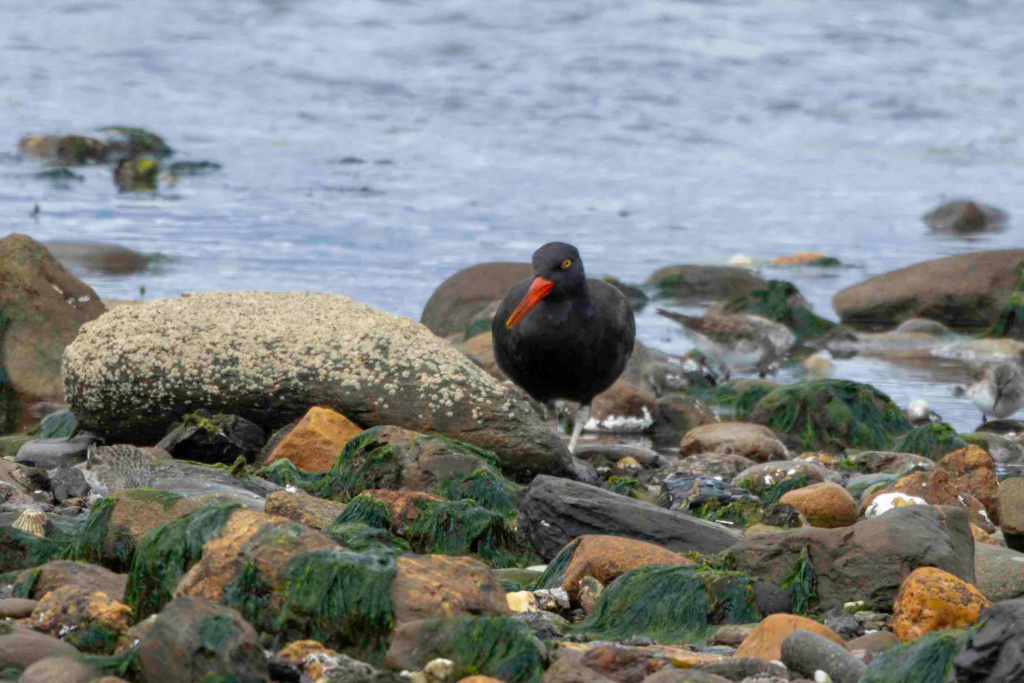
This species is found along the Pacific Coast of South America, from northern Peru, along Chile, to Tierra del Fuego and Cape Horn, then continuing north along the Atlantic Coast to central Argentina.
It’s all black body, with a yellow eye, red eye-ring, heavy red bill, and pinkish legs.
This picture was taken in Ushuaia, Argentina, on December 5, 2004, the day before we boarded the ship for our Antarctica adventure with Roads Scholars. We saw it in the same area as the Magellanic Oystercatcher.
The other Oystercatcher species I hope I might see some day are the following:
In New Zealand: South Island Oystercatcher (Haematopus finshci); Variable Oystercatcher (Haematopus unicolor); Chatham Island Oystercatcher (Haematopus chathamensis). The last one requires a special trip from mainland New Zealand to the Chatham Islands, about 500 miles south of the mainland.
In Australia: Pied Oystercatcher (Haematopus longirostris) and Sooty Oystercatcher (Haematopus fuliginous).